
Real-Time Data Stream Demo
In-memory live data stream showing a chart and dataframe.
The Industrial Intelligence Layer
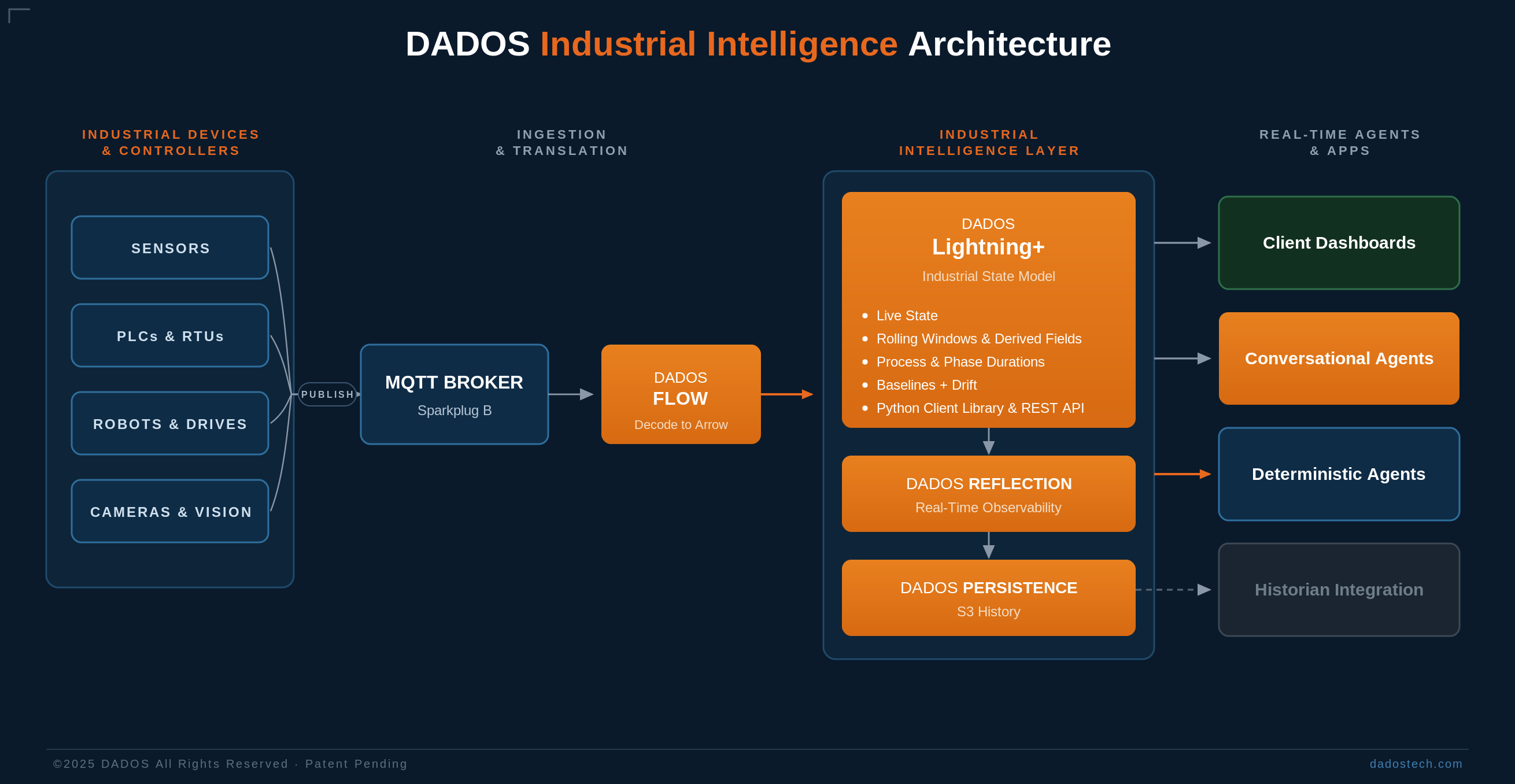
DADOS delivers decision-ready industrial state in milliseconds by converting live Sparkplug B telemetry into queryable Apache Arrow tables for control.
Industrial intelligence only matters if it allows decisions within the control timing-window. Anything slower is too late to matter.
Industrial control does not care how fast individual components are.
It cares how long it takes for live telemetry to become queryable state.
DADOS measures time from:
This fits inside supervisory control timing budgets — while conditions are still changing.
In industrial control systems, decisions must be made within tens of milliseconds, but not all decisions live in the same timing tier.
Typical Timing Envelopes
Industrial control operates across multiple timing layers.
DADOS is designed for supervisory and coordination loops — not PLC scan-cycle execution.
Handled entirely by the PLC.
DADOS operates quickly.
Any longer than that – the loop closes, intelligence cannot influence control.
Low-latency Sparkplug B message delivery through brokers is required, but control depends on when decision-ready state becomes available—not when messages arrive.
Sparkplug B provides structured telemetry, but control-relevant decisions require more than delivery:
All of this must occur within the supervisory control timing budget (50–100 ms) — not afterward, and not inside the PLC scan cycle.
DADOS converts Sparkplug telemetry into clean, time-aligned, queryable state as it arrives.
This processing occurs:
The result is decision-ready state available within the tens-of-milliseconds window required for supervisory control and coordination, without extending or interfering with PLC execution.
Our speed opens decision making opportunities not otherwise possible, because the necessary intelligence arrives in time:
Late intelligence cannot influence control — only explain it.
PLC control runs in 10–20 ms.
Supervisory decisions run in 50–100 ms.
DADOS is explicitly designed for the supervisory tier.
The constraint in industrial systems is not telemetry — it’s how fast live telemetry becomes decision-ready.
DADOS removes that constraint by separating transformation, state, and decision latency into components that operate in parallel.
Sits next to the broker. Decodes Sparkplug, enforces schema, and converts telemetry into clean, decision-ready state as it arrives. No downstream delay.
Maintains a rolling, in-memory view of what is happening now. Provides immediate operational context without querying historical systems.
Exposes the same live state, optimized for sub-5 ms queries. Supports deterministic logic, agents, and automated control decisions before the loop closes.
Aligned state and latency allow action before the loop closes.
Real-time control requires more than fast transport.
It requires decision-ready state that is:
Without this foundation, intelligence arrives too late to matter.
Industrial systems move data fast.
But decision-ready state arrives too late.
Most stacks optimize message delivery, then defer decoding, alignment, and state formation to downstream systems. Under load, latency grows — and intelligence arrives after the control window closes
Fast transport isn’t enough.
Control requires decision-ready state inside the loop
Meeting control-loop timing is not about making one component faster.
It requires an end-to-end data path designed for millisecond deadlines.
DADOS provides a single, purpose-built execution path:
Together, these form a direct path from telemetry publish to usable, queryable state — without batching, ETL, or databases in the decision path.
The result is decision-ready state delivered fast enough for agents, automation, and analytics to operate inside the control window.
The real-time performance shown below is the result of an architecture designed to deliver decision-ready state within control-loop timing — not isolated component speed.
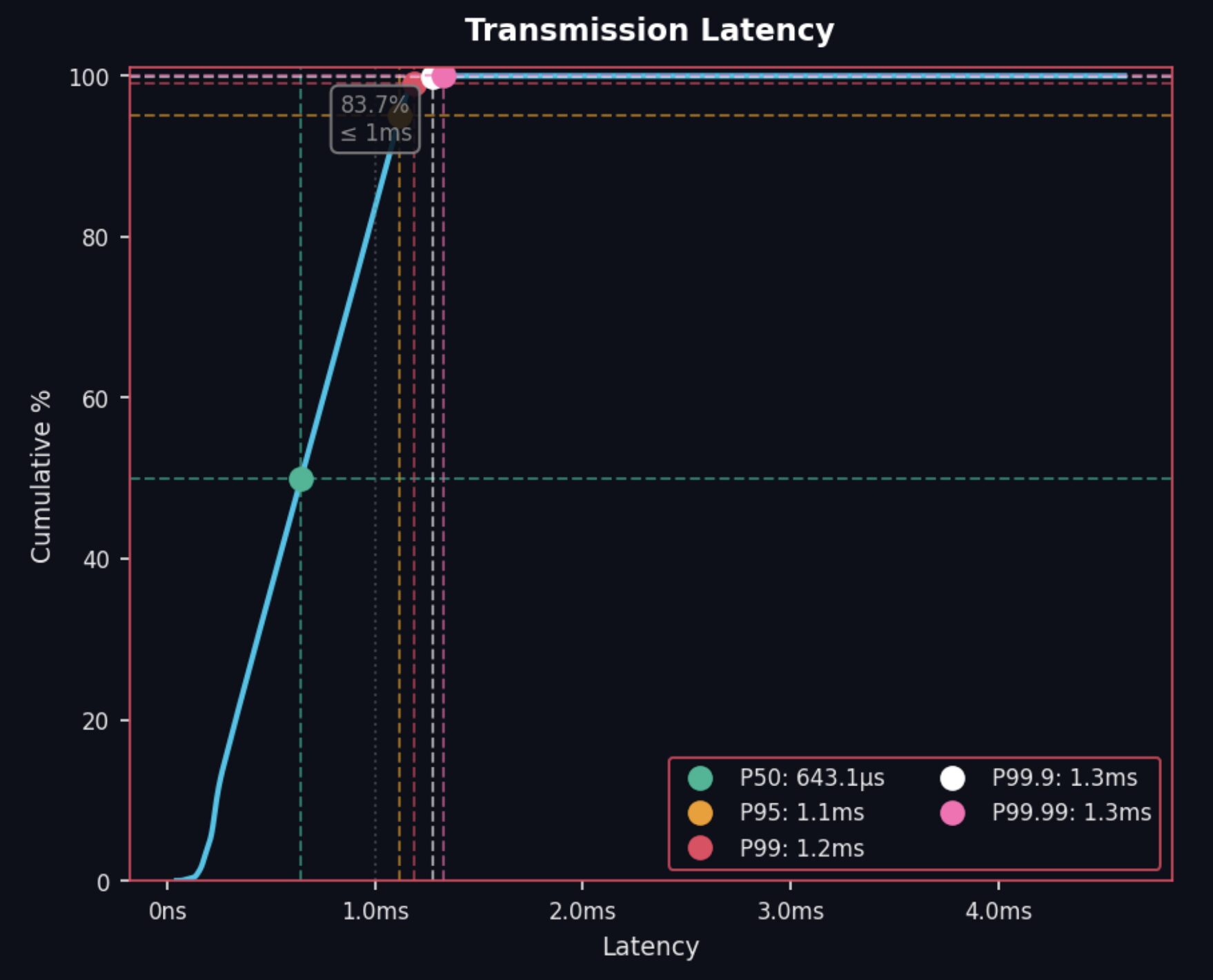
DADOS measures the only latency that matters: end-to-end time from live telemetry to decision-ready state.
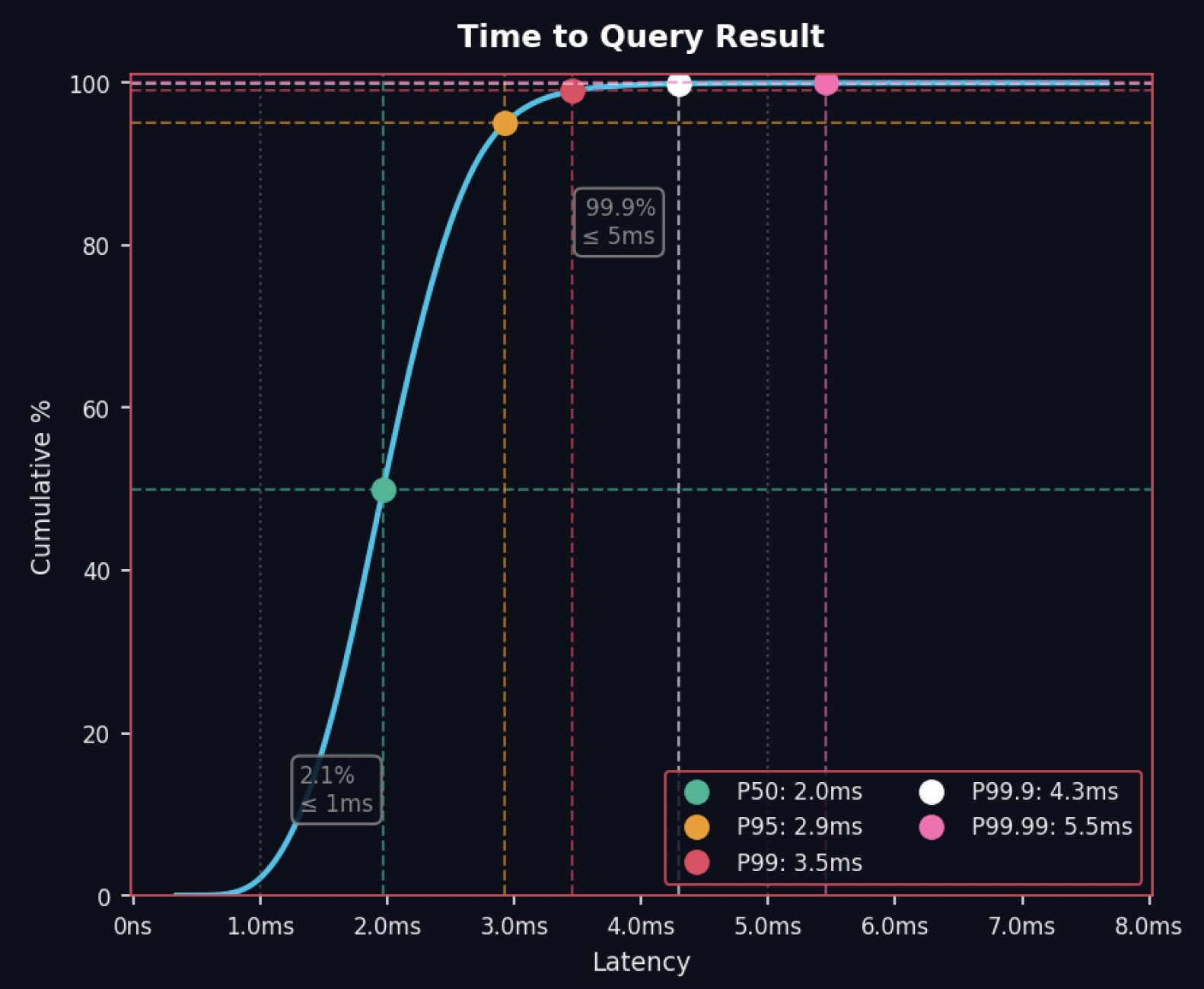
Under sustained load, DADOS delivers sub-50 ms end-to-end state readiness and 2.89 ms median query latency (sub-5 ms P99) via the Lightning+ API.
This architecture is protected by a pending U.S. patent covering high-volume, real-time message stream processing and state construction for control-loop operation.
Benchmarks include the full execution path:
No ETL layers. No historical databases in the decision path.
End-to-end latency includes ingest, decode, schema normalization, conversion to Apache Arrow, and state readiness under sustained load.
Single-message timings, warm-cache runs, or best-case measurements are excluded.
Most industrial systems benchmark throughput or isolated component speed.
Those numbers do not indicate whether intelligence arrives in time to influence control.
DADOS benchmarks whether live telemetry becomes decision-ready — and remains predictably queryable — within the supervisory control window.
Because decision-ready state arrives on time and queries execute with deterministic latency, DADOS enables:
to operate while control decisions are still possible, not after the loop has closed.
In-memory live data stream showing a chart and dataframe.
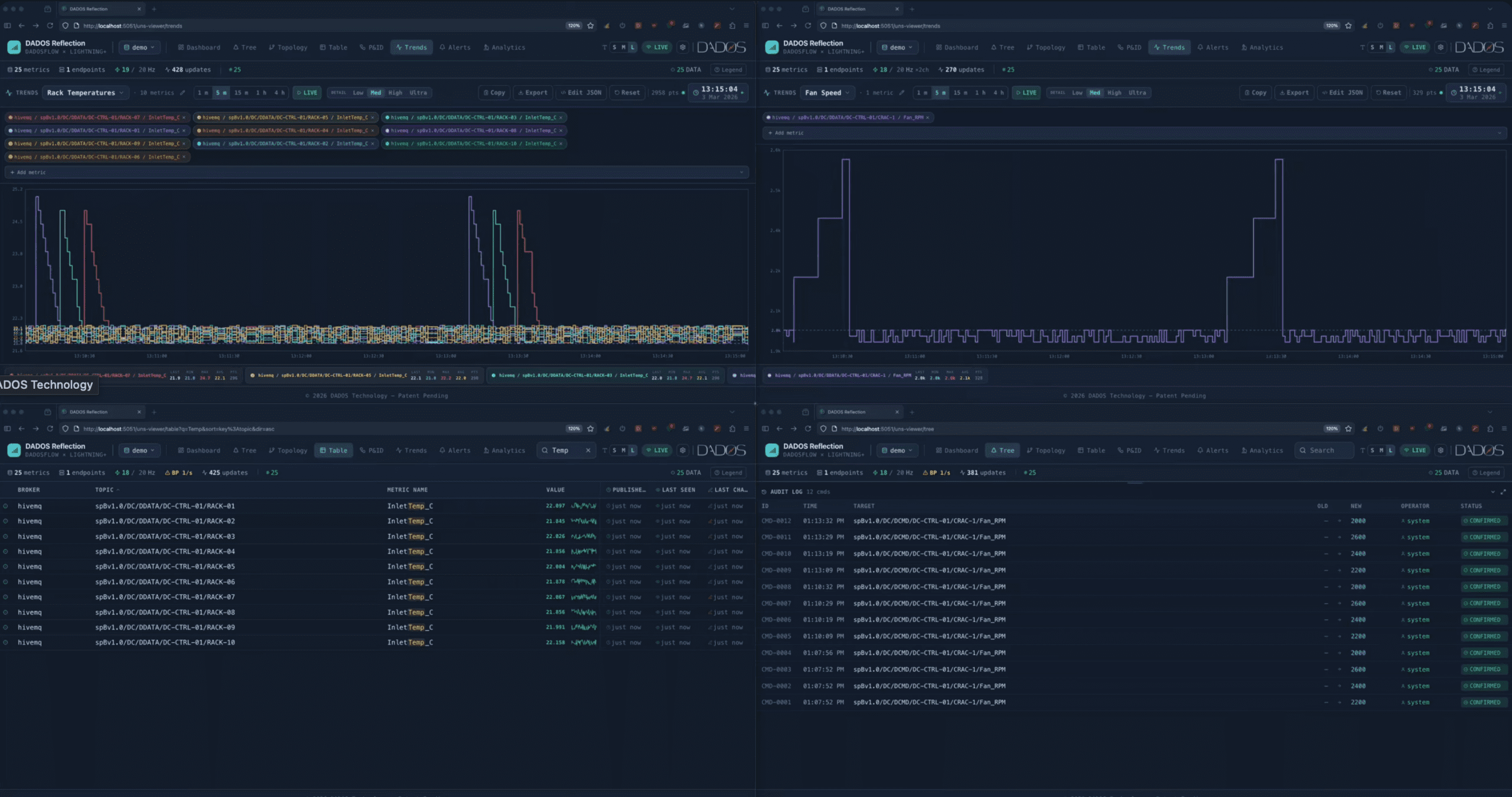
Ten server racks operate in steady state while CRAC-1 maintains cooling at 2000 RPM. Three racks overheat to 25 °C, creating a localized thermal fault.
Live telemetry triggers an automatic response, ramping fan speed to 2600 RPM. Temperatures stabilize and PUE adjusts — all within real-time control limits.
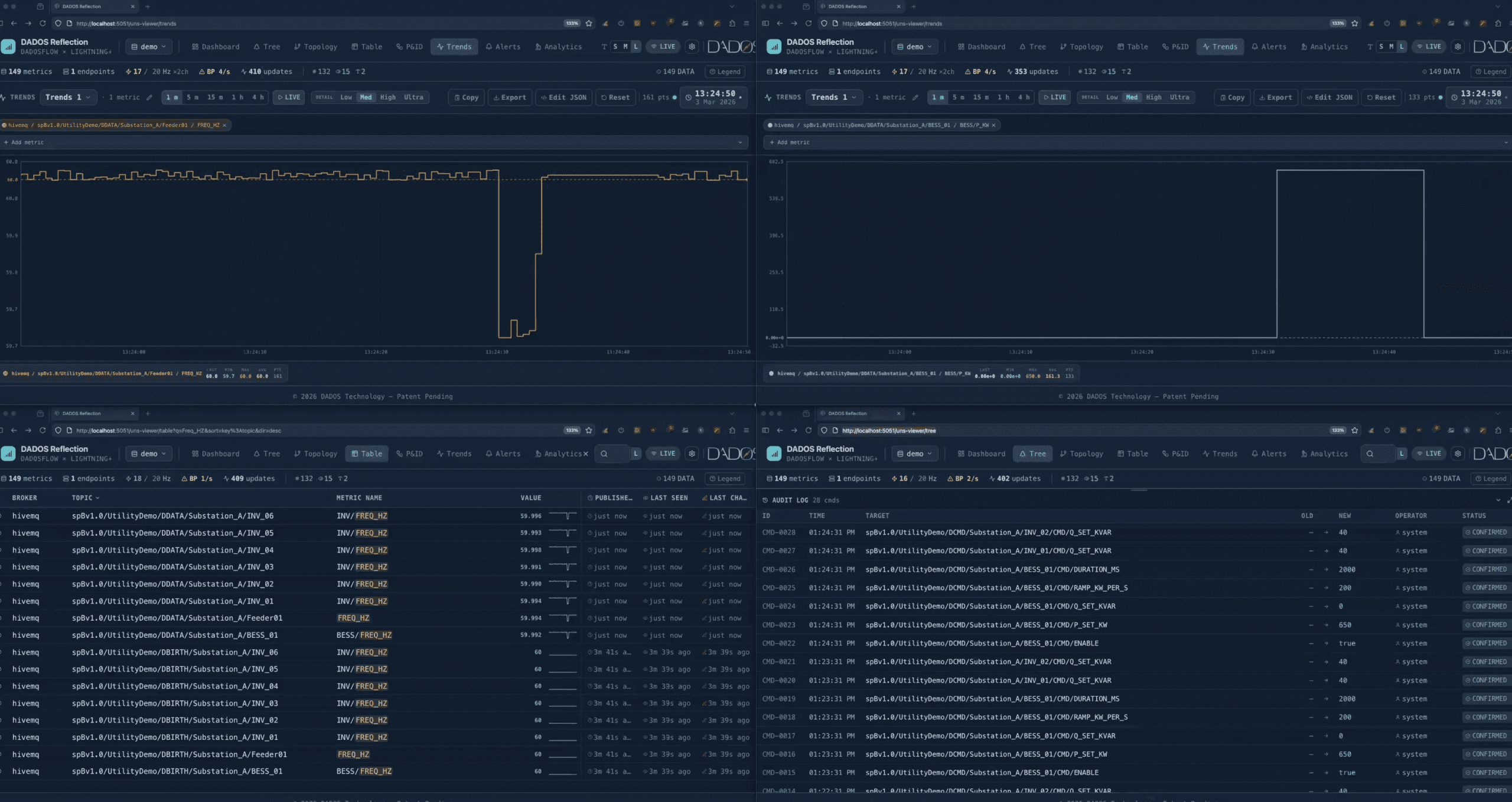
A distribution feeder operates in steady state with six solar inverters online. When grid frequency drops from 60.0 Hz to 59.7 Hz, the system detects excess demand in real time.
A DCMD places BESS-01 into frequency-support mode, ramping output by 650 kW within configured limits and holding briefly.
Frequency stabilizes and the system returns to normal operation — without manual intervention or control rewiring.